“Really, you’re that upset about a dog?”

A mixture of anger and sadness ran through me. Yes, I’m that upset about our dog dying.
And I’ll tell you why,
BG was introduced to visitors, family and friends as our brother dog by my 3 sons throughout childhood. BG came into our home when the boys were aged 1, 3, and 5 years old. He died when they were 12, 14, and 16 years old. He was literally the 4th boy in the house. When I corrected any of the boys, BG appeared at times to sulk also. He came trick or treating at Halloween, mask attached to his back. He was dressed up in Star Wars pyjamas because he looked like Chewbacca, (Fluffy Bearded Collie or think Sprocket from Fraggle Rock, if you can remember that far back!). I have never found a birthday party photograph without him. He stole the burgers at BBQs; he ate shoes; he ate furniture; he hated the postman; he hated birds being in his garden. He drove us crazy but made us laugh too. He made me cry but he taught my boys to love deeply, unconditionally, kindly, and empathically. He was a true friend, partner in crime, and yes, he taught me too.
He made me cry but he taught my boys to love deeply, unconditionally, kindly and empathically.
As he came to the end of his life he taught me, that for the first time in my role as parent, I could not fix what was about to happen for my children. I could not even attempt to make it easier for them. I recognised the boys were experiencing deep pain and all I could do was hold the space for them. As a therapist, I understand the process, that we must experience the pain of loss, understand that we have to accommodate the reality of loss, accept the reality of the loss, and learn how to live without the deceased. Yet, as a mum, I tried to shield them and protect them. I held myself tight. I cried in private. I did not dare show them how utterly heartbroken I was too.
The night before BG died, I had arranged for the vet to come to our house, so he could die at home. BG had always been very dramatic visiting the vet’s surgery and stiffened in the car. I often had to drag him out of the back seat. I felt it might be kinder and be more comfortable for us all to have him die in the home he loved. So, knowing this was going to happen the following afternoon, I sat on the sofa and BG came and sat on my lap. That is when the floodgates opened. I cried and cried, and to use a term which may be pure Kilkenny or not, I hegged.
One of my sons came and sat beside me. He wrapped his arms around me and BG and he cried too.
Later that evening he said to me “I’m glad I saw you cry Mum, that allowed me cry”. So, even with my training as a bereavement therapist, even with my understanding of what is necessary for us to be able to experience of pain of loss, I stood in my Mum’s shoes and tried to protect my children.
“I’m glad I saw you cry Mum, that allowed me cry.”
By modelling appropriately to the boys, showing I was upset, that I too would miss BG so much, I provided a space for them to be able to explore what this relationship with their brother dog had meant to them and how they would manage without their beloved dog in their lives.
By modelling appropriate grief to the boys, they felt safe to show their feelings. Of course, it was understandable I wanted to protect them from the pain of loss but by gently showing the way, they began to understand that all emotions are ok. They did, as time passed, accept the reality of their loss and they experienced and expressed their pain. Loss is extremely painful, but when supported, we can start to remember the good times in tandem with the loss. This provides the oscillation or the puddle jumping (children’s grieving style) we need to grieve and live our everyday life in tandem.
The loss of a pet is often a child’s first experience of grief. As with the death of a person, we grieve in keeping with the relationship we had with the deceased. One of my children grieved his buddy who had slept on the end of his bed for 9 years. I had eventually given up the battle of no dog upstairs, when I realised BG was a great source of comfort in the middle of the night.
Another boy grieved the feel of the silky soft fur. I had witnessed from the beginning of their relationship, BG being nine weeks old and said son 3 years old, that when BG was rubbed by this child, the experience very much activated his sensory awareness. He needed sensory comfort in his loss.
The other boy lost and grieved his companion in devilment. He needed to talk and remember their escapades.
In essence, we grieve in response to the relationship we had.
Each grief is as unique as a fingerprint or paw print. There is no right or wrong way to grieve.
As parents, we sometimes need to recognise that seeking support after pet loss can be very helpful. One of the greatest supports I experienced was from our vet. He was amazing with my boys and sat and discussed the process of BG dying. They had a choice as to whether or not to stay with their buddy and this really gave them a sense of safety and comfort.
And finally, I want to thank the kindest, most infuriating, fluffy dog I have ever known. Thank you for being such an amazing friend to my children and teaching me how to support them in dealing with and managing their loss. You are remembered on our Christmas tree every year. The pain of grief we felt has been transformed back to love and we chat regularly about the adventures the four of you got up to.
Thank you BG.
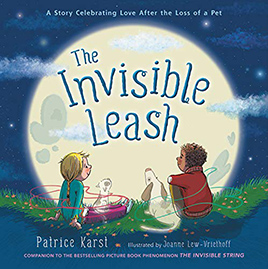
The Invisible Leash by Patrice Karst is one of many incredible resources available to help navigate the loss of a pet. This particular book about pet loss is beautifully illustrated and so sensitively written.
The Irish Hospice Foundation has a workshop scheduled for 2026 aimed at professionals and those in a support role to those that have experienced pet loss. Pet Bereavement Tickets, Thu 7 May 2026 at 09:15 | Eventbrite